The Yoro Biological Corridor Initiative is an effort to link eight Honduran national parks threatened by conventional coffee production. The legal establishment of the corridor by the Government of Honduras will seek to promote and build on the forest protection and restoration efforts of the park Co-Managers. The initiative involves an Off-Grid Solar-Dried Coffee Processing Facility linked with Integrated Open Canopy™ farming; in the creation of a carbon trading program to conserve and restore forest habitat on private lands throughout the Corridor.
The Corridor creates and supports the skills required to adopt renewable energy (solar & biofuels) for rural productive applications, carbon accounting and measurement skills required to increase the sale of carbon offsets to the international market.
The $68 million, 10-year initiative has been prepared for presentation to the Green Climate Fund in conjunction with the Biodiversity Division of the Environment & National Resources Ministry and Honduran Forest Service. To date the Mesoamerican Development Institute (MDI) has provided 250 presentations at meetings with stakeholders, government ministries, and potential funders. The Initiative has broad support from the public, NGOs, and the public and private sector, with over 35 public hearings to date.
Yoro Biological Corridor Metrics
12,000 square kilometers
26 municipalities
Includes participation of indigenous community (Federation of Xicaque Tribes, Yoro, Honduras (FETRIXI))
Current coffee production of 1,486,685 qq
Current area of coffee cultivation 52,247 Ha or 129,106 acres
15,266 registered coffee producers
Total population approximately 884,660
Ten threatened protected areas
Endorsements
National Autonomous University of Honduras (UNAH)
The Institute for Forest Conservation (ICF) (Honduran Central Government)
The National Electric Generation Company (ENEE)
The President’s Office on Climate Change
The Ministry of Natural Resource & the Environment (MiAmbiente)
The National Council for Sustainable Development (CONADES)
The 11 Mayors and Governor of the Department of Yoro, supporting the Co-Management of Pico Pijol National Park and the Yoro Biological Corridor
The US Forest Service (Department of Agriculture)
The US Fish & Wildlife Service (Department of Interior)
The University of Massachusetts
Tulane University
Cornell University
The American Bird Conservancy
International Partners in Flight
The Global Environment Facility (GEF) Secretariat
A growing coalition of coffee companies promoting Cafe Solar® internationally.
Source: Information collected and summarized by Merchants of Green Coffee Inc. from our own corporate documents, in addition to those of our partners; Mesoamerican Development Institute (MDI).
Meeting of Advisory Committee to Complete Legal Request to Establish the Corridor
This Yoro Biological Corridor Meeting Report marks a historical point in the Corridor’s development, as it finalized the legal framework to implement the progressive model of regional and interconnected sustainable development. Main objective(s) of the meeting included:
The legal submission of the YBC was completed on December 22, 2021 (a.k.a. the legal documentation under the forestry law for creating biological corridors). This was the final requirement in a 4-year process for Mesoamerican Development Institute (MDI) to submit to the Honduran government for the legal establishment of the Yoro Corridor. The advisory board is made up of experts in their fields and submitted to ACTA.
Meeting Details
Who: Coffee producers, members of the Honduran Network of Private Natural Reserves (REHNAP), members of the College of Forestry Engineers, Merchants of Green Coffee, and MDI field researchers and international students. What: Meeting to complete the final legal documentation to request the legal establishment of the Corridor. Where: Online on Zoom meeting platform. When: Wednesday, December 22, 2021 @ 2:00pm EST Why: To legally request the establishment of the Corridor in order to promote investments in biodiversity, sustainable development and forest restoration. (MDI is currently co-managing two national parks within the Corridor).
Conclusion & Next Steps
The legal documentation for the YBC was filed with El Instituto de Conservación Forestal (ICF) on the final week of 2021 by the Mesoamerican Development Institute, Honduras.
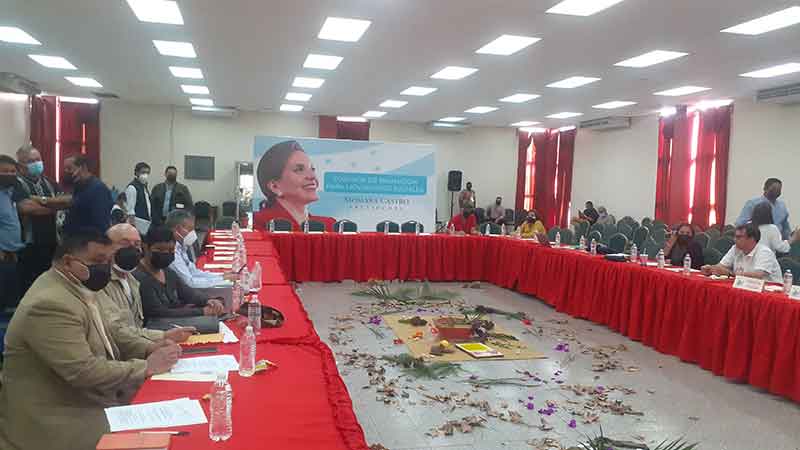
As Co-Managers of two national parks—Pico Pijol and Montaña de Yoro National Parks, MDI was invited (at a follow-up meeting on Friday, January 7, 2022) to meet with the incoming administration to discuss Co-Management, and also introduce the Yoro Biological Corridors Initiative to the new representatives of the Xiomara Castro Administration. We’ve been instructed on how to send our Yoro Biological Corridor proposal directly to the incoming president. We will be following up, asking them to move quickly on establishing the Corridor and to provide any No-Objection Letter that may be required for the international development banks and Green Climate Fund with which we are currently engaged. MDI will be submitting the “YBC package” to the new president by Friday, January 14, 2022.
A photo from the follow-up meeting in Tegucigalpa, Honduras on Friday, January 7, 2022, at Universidad Pedagógica Nacional Francisco Morazán (UPNFM), in preparation to submit the Yoro Biological Corridor package directly to the newly elected government.
Interesting Facts
Honduras is the only Central American country with a law to establish legally protected Corridors. This is a progressive development in dealing with biodiversity and climate change!
Honduras is the second Central American country to elect a female President.
The Corridor process is expensive and complicated and Yoro Biological Corridor™ is the most advanced Corridor program in Honduras.
MDI is currently co-managing two national parks bordering the Corridor.
The process of legally establishing the Corridor and co-managing the parks is providing the opportunity for Honduran students to study and obtain advanced degrees in the US.
The research coalition will model the impact of Cafe Solar®’s clean technology and forest-restoring coffee cultivation on watersheds, forest, and livelihoods in order to guide its scale-up. The National Science Foundation (NSF) is funding the Cafe Solar® program to the tune of $3.4 million.
“The resulting system produces high-quality coffee, restores and conserves high-elevation forest critical to healthy watersheds, biodiversity (including migratory birds), while enhancing employment and revenues critical for community stability,” says Richard Trubey, director of program development at Mesoamerican Development Institute (MDI).
“This funding couldn’t come at a more needed time, as coffee is driving deforestation and threatening national parks, and the business as usual approach combined with the pandemic is causing many coffee farmers and skilled local youth to seek alternative sources of income and even risk emigrating to the United States,” Richard adds, “We need these farmers and talented young women and men, just as much as a development program of this nature needs major upfront financial investment to move it forward until the model becomes self-sustaining.”
The money will allow MDI to continue funding local researchers, and to further develop the higher education of the Honduran researchers. The research will aid the production of Cafe Solar® coffee, in an effort to help satisfy the global need for low carbon (and net zero) coffee supply chains.
Scientists Cooperating to Address Climate Change via Coffee
This NSF Growing Convergence Research Project brings together conservation biologists, ecologists, agronomists, farmers, indigenous peoples, economists, social scientists, land managers, and engineers to co-design and implement a system for sustainable coffee production.
The $3.4 million project includes Tulane University; the University of Massachusetts, Amherst; University of North Carolina; and Indiana University of Pennsylvania.
Convergence research is a means of solving vexing research problems, in particular, complex problems focusing on societal needs. It entails integrating knowledge, methods, and expertise from different disciplines and forming novel frameworks to catalyze scientific discovery and innovation.
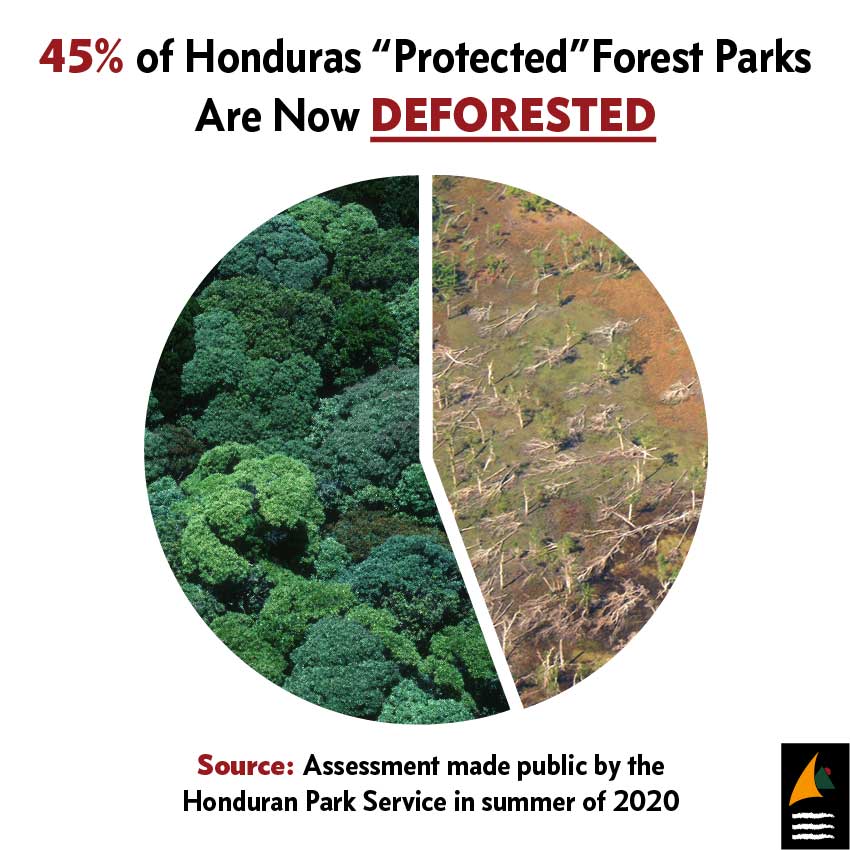
The following Yoro Biological Corridor Meeting Report marks a significant point in the Corridor’s development, as there is a recognized crisis (45% of protected Honduran Forest Parks have been deforested in the last 10 years) and it has become critical to find a more efficient means for stakeholder engagement (i.e. conference call meetings at a distance).
The Yoro Biological Corridor is is an effort to link eight Honduran national parks threatened by conventional coffee production. The legal establishment of the corridor by the Government of Honduras will seek to promote and build on the forest protection and restoration efforts of the park co-Managers, including our Cafe Solar® team.
Meeting Details
Who: MDI + DIBIO (Directorate of Biodiversity) + MGC presenting to 32 mayors/municipal districts What: High Level Multisectoral Stakeholder Engagement Meeting Why: To achieve legal establishment of the Yoro Biological Corridor (which has an area spanning 32 municipalities) Where: Online on GoToMeeting platform When: Wednesday, December 9, 2020 @ 12:00pm EST
Meeting Summary
The plan: To provide a unified presentation to the 32 Mayors of the Yoro Biological Corridor for the first time via online meeting platform. The main purpose: To advance the process for the legal establishment of the Yoro Biological Corridor.
Presentations were given by: Richard Trubey (MDI), Raúl Raudales (MDI), Kelly Diaz (MDI), Rene Soto (DIBIO), Martin Murillo (MDI), Fabiola Rodriguez (MDI). Not all mayors were able to connect; however, this new online format will now be used as a model for education and cooperation at a distance, and the meeting recording will be quickly disseminated to all those who could not connect.
What Made This Meeting Significant?
A forest corridor involves and affects so many people/stakeholders that finding ways of connecting them efficiently has historically presented a major multi-sectoral challenge. Now that meeting online is more widely accepted, we are using an online meeting platform to expand and accelerate the reach. These presentations are being recorded and will be posted to the Mesoamerican Development Institute (MDI) website for more efficient stakeholder engagement.
This Stakeholder Engagement process has been active for four years and started with a handful of participants (more than 150 presentations to date). This new online conference format is necessary in order to efficiently address the urgent need for the legal creation of the Yoro Biological Corridor. The initiative is spearheaded by MDI Honduras S. de R.L. and its Off-Grid Carbon Neutral Facility—which is scheduled to be operational for the 2021/2023 harvest. The new facility will be the value generating hub for the Yoro Biological Corridor. Currently MDI is exporting Cafe Solar® from the pilot facility operating in the town of Subirana, Yoro for the last 8 years.
In this podcast Fabiola Rodriguez, doctoral student from Tulane University, talks about coffee growing and migratory birds in the context of her areas of study: ornithology, ecology, and conservation. She also compares types of coffee farms and how they affect bird habitat.
Fabiola has been researching bird populations in Integrated Open Canopy™ coffee farms for the past several years and is mentoring a team of five local biologists in coffee regions surrounding Pico Pijol National Park, Honduras, with over 100 study sites.
Migratory bird populations are on the decline and coffee farms can act as critical habitat for these threatened species. North American migratory birds call Canada and US forests “home” (their breading grounds) but fly all the way down to Central, South America and Caribbean tropical forests every year to spend the winter. Since the natural, annual life cycle of these birds spans two continents there is a need for suitable habitat in two very different parts of the world, and unfortunately habitat loss has been rising while bird populations have been declining.
“A staggering loss that suggests the very fabric of North America’s ecosystem is unraveling.”
—Cornell Lab director John Fitzpatrick and study coauthor Peter Marra
Writing for the New York Times, journalist Carl Zimmersums up nicely why we should view birds as our feathered friends: “Common bird species are vital to ecosystems, controlling pests, pollinating flowers, spreading seeds and regenerating forests. When these birds disappear, their former habitats often are not the same”.
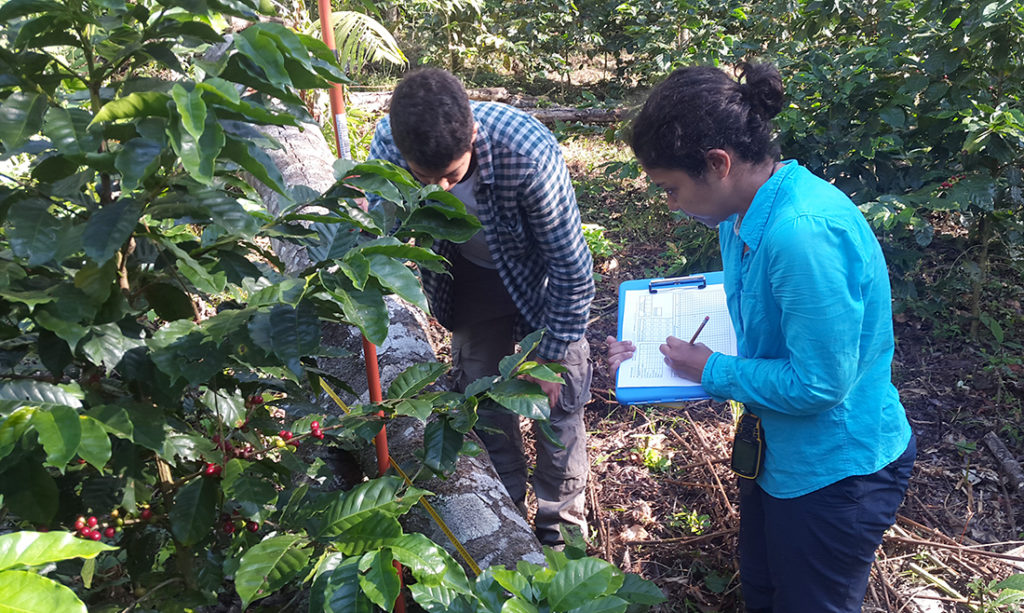
Fabiola Rodriguez in the field studying birds on coffee farms in Honduras.
As far as coffee and birds are concerned, the connection has to do with the birds being able to select the best habitat for survival over winter, in order to make it back home in spring. The best option is obviously natural forests, but as the forests evolve into what she describes as “working landscapes” (that need to sustain people), new wintering habitats may include cattle farms (which have little to no trees); deforested areas (due to lumber, mining, etc.); and certain agricultural farms, like coffee farms (which are more ideal as a softer transition for the birds than cattle, for example).
The question Fabiola poses is, “Can these working landscapes sustain these species?” … And the answer is, yes! Bird-friendly coffee can offer a solution.
Q. Are there types of coffee farms that tend to be better at sustaining migratory bird populations than others?
A. Yes. The three types of coffee farms Fabiola sees and works with:
Sun coffee farms. These types of farms have only coffee trees (which are lower-to-the-ground shrubs). This monoculture coffee farm has a harsh, hot environment that supports the least number of migratory birds.
Shade coffee farms. These types of farms spare (or “leave in tact”) some trees and forest amoungst the coffee trees; however she mentions that shade is by no means a closed canopy and that it varies from a handful of trees here and there to a bit more shaded in some areas. It’s never a thick canopy because the coffee trees need some sunlight, and from her research she finds percentages of shade cover to be extremely variable; however, shade coffee farms support more bird species than sun coffee farms.
Integrated Open Canopy™ (IOC) farms. These types of farms are defined by “land-sparing”. Fabiola: “Imagine a coffee farm, which can have sun or some shade, and then right next to it a patch of forest that is equal in size. This is a method that has been recognized in the conservation literature as land-sparing, but in terms of coffee it also has another term … in Honduras, we know it as Integrated Open Canopy™ (IOC). The idea is that when you have many of these types of land-sparing farms you actually connect the landscape with trees and forests. It’s a method of production that was introduced by the Mesoamerican Development Institute (MDI), which is an NGO I collaborate with when I’m in Honduras. They’re trying to make this form of production sustainable because it is conserving forest and forest at the end of the day is the natural habitat; so if you were to have this idea expand in the landscape it would have a very positive effect. And it’s especially positive because in Costa Rica where they’ve also studied these IOC farms, some of my collaborators found they had a higher species richness of forest dependent migratory birds than shade coffee farms.” So in conclusion, IOC farms are proven to support the greatest numbers and diversity of forest-dependent birds species.
Fabiola goes on to explain that collaborative researchers are also discovering that IOC coffee farms are having similar positive effects on, not just migratory birds, but other animal and insect species; in addition to significantly improving water and soil quality in the region. In the second half of the podcast: Fabiola talks about coffee farming, monocultures vs. biodiversity, coffee processing, and, another important issue, the fact that coffee processing is fulled by burning forest wood. “Approximately 6,500 hectares of forest in Central America are lost, not from planting coffee, but from drying coffee.”
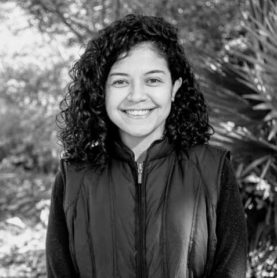
Fabiola Rodriguez is a doctoral student from Tulane University researching bird populations in Integrated Open Canopy™ coffee farms for the past several years. She is from Tegucigalpa, Honduras and is mentoring a team of five local biologists in coffee regions surrounding Pico Pijol National Park, with over 100 study sites. This makes her a Mesoamerican Development Institute (MDI) research collaborator.
Fabiola studied biology in Honduras and fell in love with observing ecosystem interactions, eventually focusing her study on ornithology. She first became a field technician, and eventually wanted to design the research and ask questions that contribute to both science and conservation, which is why she went on to complete her doctorate degree.