Click the image above to download a copy of the report
The Coffee Barometer Report points to the major problems in coffee right now: Greenwashing and Exploitation.
Writer, Kristen Motz, was spot-on with her analysis of the 2018 Coffee Barometer Report when she wrote: “As I read the last sentence of the 2018 Coffee Barometer report, it left me thinking of the Honduran phrase “tilin-tilin y nada de paletas.” It means the ice cream truck is empty or, in other words, “all talk but no action.””
Today’s situation is no different. On page 27 of the latest report it states, “While the importance of increased transparency is widely shared across the industry, the results of these sector-wide instruments are disappointing.”
The low global coffee trading price (which is set by the NY Commodities Exchange), plus lack of environmental transparency (by industry leaders); all fueled by consumers’ love for getting this product at a discount, is causing a crisis situation for many producers.
Economic Situation in Honduras at Worst in 60 years
Honduras, (where our flagship coffee program is located), is in its worst economic situation in 60 years, due to COVID coupled with two devastating back-to-back hurricanes. If the coffee industry could find a way to pay a fair price to growers the situation could improve.
According to the New York Times World COVID-19 Tracker: As of April 13th, Honduras as administered less than 60,000 doses of vaccine – less than 0.1 percent of the population has been fully vaccinated.
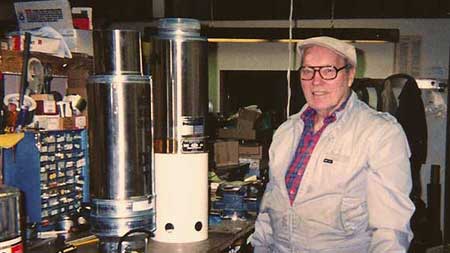
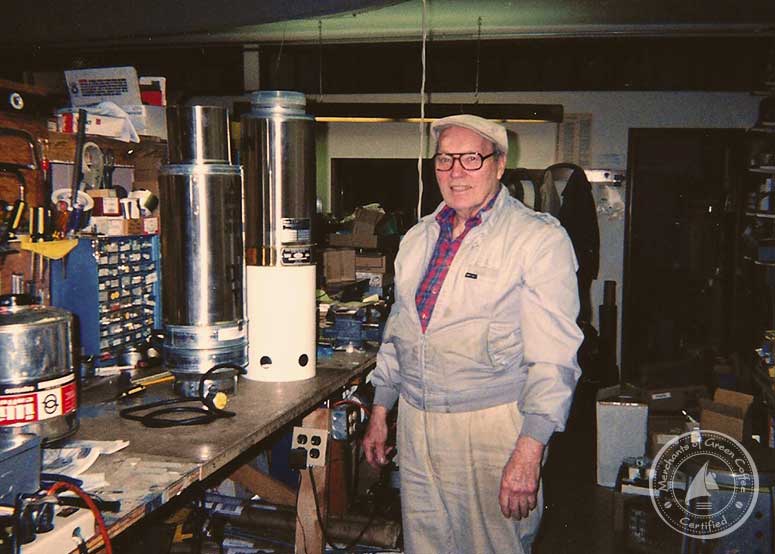
Michael Sivetz, World Coffee Expert, poses for a picture at his roaster assembly bench in his coffee church in Oregon.
Coffee lovers can learn a lot from Michael Sivetz, an American coffee guru who spilled the beans on corporate coffee industry greed not long ago. This unknown-to-most ‘World Coffee Expert’ is responsible for publishing some of the most controversial coffee truths and exposing corporate deceit, making him a great American whistleblower that deserves widespread recognition.
He also happened to be our friend and coffee teacher (which has always felt somewhat surreal); And before we get to that and the part about how he spilled the beans, a quick glimpse into Sivetz’s exceptional life …
University Science Graduate Turned World Coffee Expert
Michael Sivetz was known, firstly, for his brilliant mind. After graduating with a Ba. & Ma. in Science in Chemical Engineering, he took it upon himself to chemically break down the coffee bean into its 800+ individual flavour components; and after doing so, went on to write the technical industry “Bible” on coffee.
The big corporations were smart to pick him up early on, and Sivetz quickly found himself consulting for some of the largest (and now oldest) coffee companies: including, J.A. Folger Coffee Co., General Foods Corp., and R&D (now Kraft); work that spanned nearly 4 decades (from the 1940-‘70s).
No small-timer in his day, coffee projects for Sivetz included things like: inventing the first, new commercial roasting technology, innovating on coffee extraction technology, and designing and building various coffee processing plants all around the world. Towards the end of his life he devoted time working with the early Specialty Coffee Association of America (SCAA) and was honoured as an SCAA Lifetime Achievement laureate.
The fact that Sivetz was considered a World Coffee Authority is widely agreed on by the coffee industry; however, Sivetz’s real life struggle is widely understated. All existing online write-ups about Sivetz are missing the degree to which his scientific findings stirred up controversy, ultimately leading him to “spill the beans” on the burgeoning multinational coffee industry. Here’s how it all unfolded …
Important Yet Controversial Coffee Books
In his lifetime Michael Sivetz published a number of books and articles containing scientific facts that, whether he meant to or not, had the effect of exposing the unethical underbelly driving the multinational coffee trade. His two most famous and “dangerous” books being: 1. Coffee Technology (1963), and 2. Coffee Quality (1987).
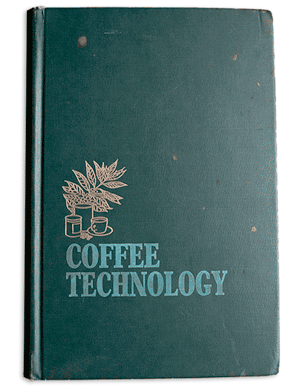
Front cover of “Coffee Technology” by Michael Sivetz (version 1979)
Coffee Technology is the top coffee industry manual (also widely known as the coffee “Bible”). This book contains much of Sivetz’s scientific research on and technical details around coffee processing technologies, plus a history on coffee and a chapter about “Coffee and its Influences on Consumers”. Since coffee professionals were the book’s intended audience, consumers rarely got their hands on a copy despite it containing key consumer information centering on coffee freshness.
His massive, molecular finding on freshness is this: Once roasted, coffee oxidizes (i.e. “goes stale”) over a period of 3-7 days, regardless of its packaging.
The inherent “problem” with this definition of freshness is that it went against the pure profit mode of an industry (since products with short shelf-lives are more difficult and costly to manage). If consumers were to have connected the dots, the information would have revealed that all of the coffee being sold to them as “top quality” was, in fact, awfully stale; sometimes months (and even years!) past peak freshness.
Despite this freshness revelation, Sivetz kept the larger part of his own opinions out of this book and continued working for the big corps for many years; nevertheless, a strong sense of disappointment brewed within him. As an industry professional, he was doing well for himself; but as a coffee-drinker, he was beginning to feel betrayed by his own community. These feelings eventually inspired him to write and self-publish his next book in which he, some might argue “unscientifically”, included some of his more personal observations …
Sivetz Spills the Beans and Takes On Goliath
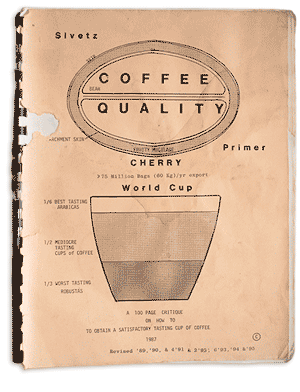
Coffee Quality is Sivetz’s big, ‘bean-spilling’ debut! This publication zeros in on the big corporations’ underlying deceit and points to the social and political issues made worse by the world coffee trade.
Front cover of “Coffee Quality” by Michael Sivetz (version 1987)
The book, which has been revised many times throughout the years, seems to be written from the standpoint of both a professional’s critique and an average coffee-drinking citizen’s plea to another coffee-drinking citizen. In the Preface he openly exposes the fact that the US mass coffee market was built on offering lower- and lower-quality coffees to unsuspecting consumers; then, goes on to expose the various exploitation he experienced.
Exposing Local Exploitation
Using marketing to mask important product information was unethical corporate behaviour in Sivetz’s mind. He starts leaking what he felt was crucial missing consumer information on pages 4-5, “In the USA, the major roasters have developed a low priced (and of course low quality) product from the lower grades of Arabica coffees; and since about 1960 have introduced (without public education) a change to their branded blends to more bad-tasting Robusta coffees … This blind rush to buy low cost, inferior quality coffee beans by the major corporations, not only has produced progressively worse tasting coffees, but has oriented the consumer to having to use more milk or cream to overcome the bad taste of what is being marketed.”
A more direct example of consumer exploitation experienced by Sivetz dealt with a roasting machine innovation called “quenching”. Long story made short: He was contracted to design a technology that sprayed water on the coffee beans to cool them after roasting, but in the end it had two major, negative side-effects that were overlooked at the time: 1. Degrading the quality and freshness of the beans, and 2. Adding 8% or more extra water-weight to the final product, resulting in consumers getting less coffee for the same price. “The addition of 8 to 10% water to roasted coffees is pure fraud unchecked,” he writes on page five of Coffee Quality.
Exposing Global Exploitation
In addition to ‘The Exploitation of Consumers’, the book includes Sivetz’s comments on topics: The Exploitation of Farmers; Smuggling; Civil Unrest; and Climatic Losses, all resulting either directly or indirectly from coffee commodification. He writes on page 26, “One of the most unfair aspects of the coffee growing business has been and still is the exploitative export taxes heaped on this commodity by their governments … It isn’t that some coffee farmers can’t become wealthy, it is just that this squeeze, forces all agricultural costs to be squeezed, especially the labour. Hence the labourers live in squalor, disease, hunger, and pain.”
The publication of Coffee Quality was Sivetz’s attempt to educate the public and it made him the first scientist to blow the whistle on a bad situation. In many ways, Sivetz is like the Rachel Carson of coffee; instead of alerting people to the toxins in our environment, he was alerting the masses to the loss of their dignity and warning of future calamities. Coffee consumers, it said, were being lied to and their coffee dollars were supporting social and political unrest. As one can imagine, the book’s release didn’t exactly advance Sivetz’s career in corporate coffee …
World Coffee Expert Turned Outspoken Outlaw
After exposing the multinational coffee industry, Sivetz was naturally marginalized. His tone was too confrontational; his research, too edgy; and its implications, too political. Nevertheless, he refused to stay quiet and became a “thorn” in the side of his associates, constantly challenging them and mocking them for selling stale coffee.
Sivetz could be found working solo more often but refused to give up his fight, continuing to expose the big corporations and directing his research towards helping the specialty coffee industry. He went on to publish, invent, patent and sell coffee beans out of an old church in Oregon well into his eighties. This was around the time we first met him …
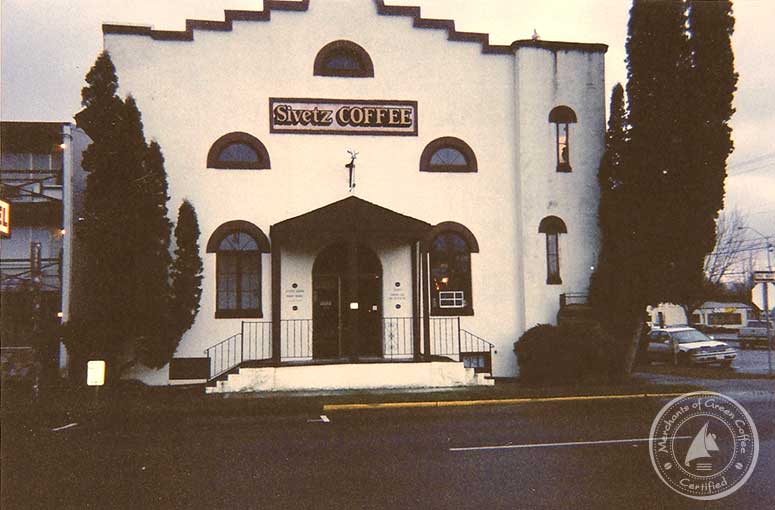
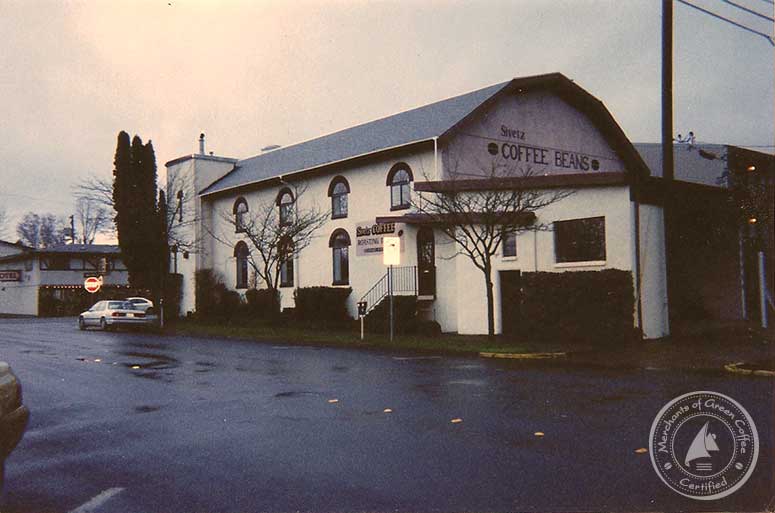
The front of the famous Sivetz Coffee church, in Corvallis, Orgeon. Sivetz Coffee church, Corvallis, Oregon.
Merchants of Green Coffee Meets Michael Sivetz
In the year after our company was founded (1995), Merchants of Green Coffee founders, on a mission to “deliver the best-tasting coffee through a supply chain with integrity …”, traveled to Oregon to meet the outlawed coffee guru.
“Sivetz absolutely confirmed our own discovery and questioning of coffee’s freshness, he became the mentor of Merchants of Green Coffee, and inspires us every single day to live the truth no matter what … no excuses,” says Derek Zavislake, co-founder and CEO of Merchants of Green Coffee.
What Today’s Coffee Lovers Can Learn From Sivetz
On March 22, 2012, at the age of 90, the world lost a coffee legend; nevertheless, Michel Sivetz’s story and expert findings are just as relevant today as they were in his lifetime.
The vast majority of coffee continues to be sold stale; forests are rapidly disappearing in coffee producing regions; farmers often receive less money than the cost of growing the coffee; the industry is increasingly monopolizing; and false marketing abounds. In short, the coffee market has a massive impact on the world and the bottom line hasn’t changed much since Sivetz exposed its shortcomings many years ago.
There is still much to do and life is short, so we end this Ode to World Coffee Expert and Great American Whistleblower with these wise words from Sivetz, “Don’t diddle!”
If you know of any other published information sources that we can list in the links below, please write to us.
Further Michael Sivetz reading …
A thorough Michael Sivetz presentation created for the SCAA on coffee taste evolution can be found here.
An excerpt from his book Coffee Quality can be found here.
This page contains some description of his work for the big corporations. A full summary of his work experience can be found in his book Coffee Quality.
Sources for this Article
Sivetz, Michael. Coffee Technology. Avi Publishing Company Inc., Westport, Connecticut: 1963.
Sivetz, Michael. Coffee Quality. Self-published by Sivetz Coffee Inc. Corvallis, Oregon: 1987.
First climate change and now COVID-19; We deal with these crises and coffee farmers do too. Our job as coffee merchants is to tell the story of the grower, and this brief account of the life of a coffee farmer in Honduras is straight from the source …
Born in a small village called ‘Subirana’ in the Yoro region of Honduras, fifth generation producer; Cindy Dubon, was raised into an established family tradition of coffee farming for subsistence. Cindy is now 32-years-old, a beautiful mother with three young children, and probably one of the youngest cooperative managers in the region. You could say that she is doing comparatively well; as a producer, a professional, and an active contributor in her community.
To communicate with the outside world, she uses her personal cell phone as well as the cooperative’s office computer, and she was more than happy to help paint this picture of what daily life is like for the people who make our cups of coffee possible.
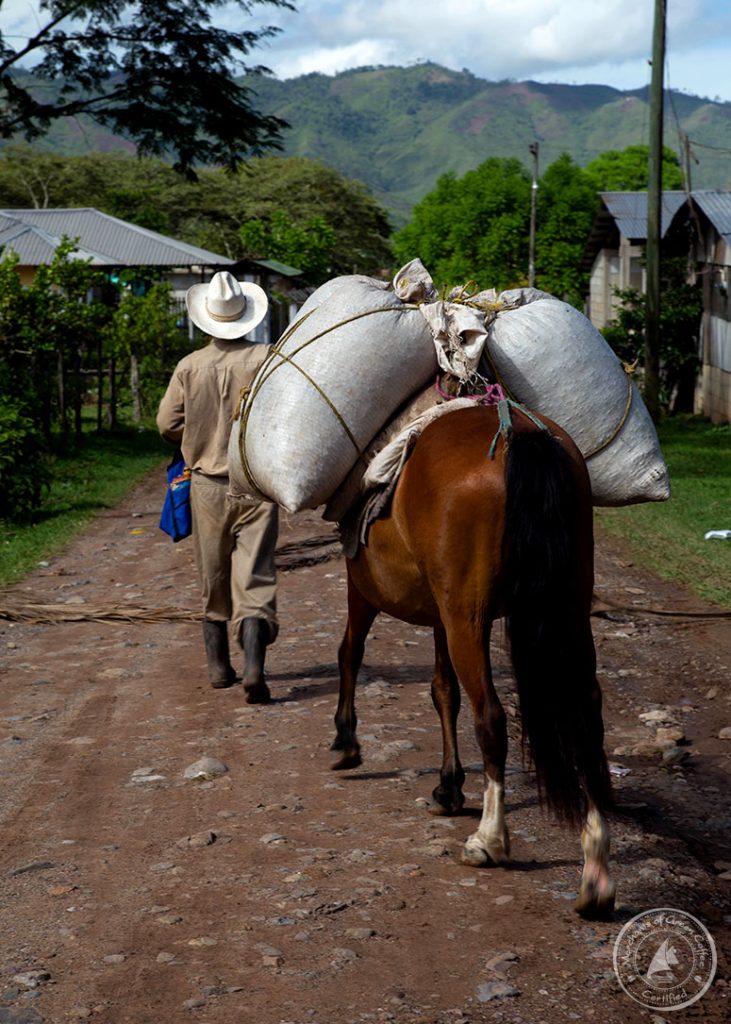
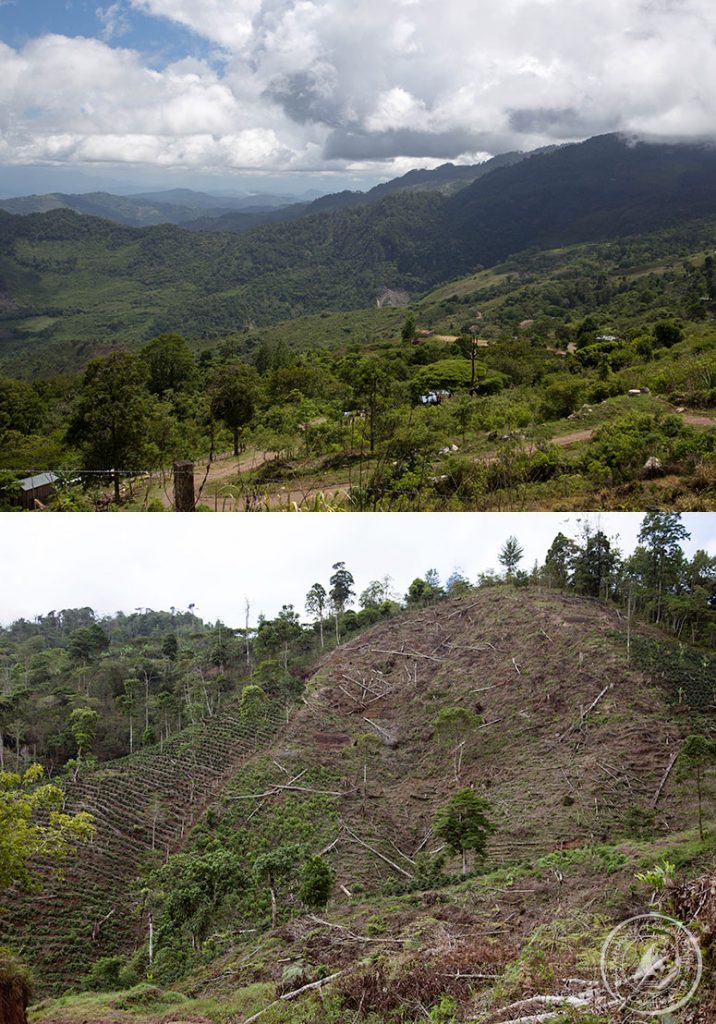
This image shows a classic example of a coffee farmer transporting his wet beans down the mountain by horse to the processing facility. The farms are mostly located at higher elevations and the coffee is brought down the various mountains to be collected at the processing facility.This part of the Yoro region is naturally beautiful and characterized by large swathes of cloud forests dotted by small agricultural communities; but evidence of deforestation is everywhere and communities are at risk of losing the natural conditions from which their livelihoods depend.
The Daily Routine
Morning or “Mañana”
Aside from the constant jungle hum of insects and amphibians, not a sound is heard. Not even a rooster pierces the chilly silence, and yet Cindy and the other women of her family; her sister and mother, rise to make breakfast. It’s 3:30am and the food must be ready by 4:30am; at which time the entire family, now including Cindy’s dad and brother, all sit down together to eat.
On the menu: rice and beans, and of course … coffee. This is breakfast every day. If it can be afforded, there may be a side of banana. After all, Honduras is the original Banana Republic and both bananas and coffee have become staples of life for Hondurans. They drink the same coffee they grow, but only the lower quality stuff. Making ends meet always involves sacrifice, and they’ve been reserving the best beans for export for as long as anyone can remember.
Work on the farm starts promptly at 5:00am in order to take advantage of the maximum amount of daylight hours. Cindy makes note that the air temperature can be quite cold at this time (17°C) and the homes lack fully enclosed walls so, contrary to what most people may think, part of the morning routine involves everyone layering on as many clothes as possible to stay warm. If it happens to be raining, they’ll be lucky if there are enough garbage bags to go around. Ensuring they have suitable PPE masks and/or mask material during the COVID-19 outbreak isn’t even a thought. “Not possible” says Cindy, “social distancing is our best and only option in most cases.”
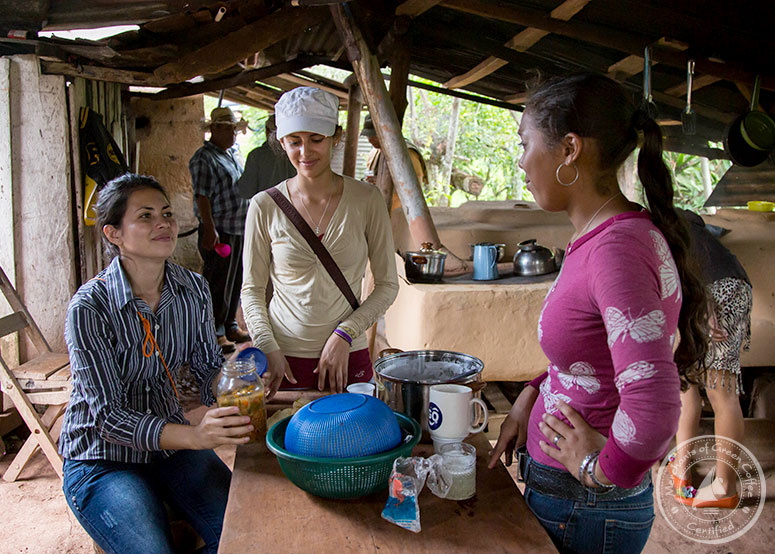
Family farms provide relative safety and security for Hondurans. Alternative forms of employment are few and many young people end up leaving their villages to search for work in the main cities where crime and dangerous jobs are more common. (Left to Right: Cindy, Tatiana, and Orbeli)
Afternoon or “Tarde”
Women of the household spend most of the day cleaning, planning, cooking, picking fruit, and taking care of any small children. In her case, halfway through the day Cindy and her female family-members meet the men in the farm with a lunch of fresh fruit and more (you guessed it!) … rice and beans. Meat is rarely consumed because it’s difficult to get and it’s too expensive for them to raise animals.
The sun is blazing hot by now (it’s well above 30°C), but an air of coolness permeates from being at such a high elevation (+1000m above sea level). After filling their stomaches, the women return to the housework and the men continue working outside in the farm until the sun goes down.
“Especially during the harvest season”, Cindy says. “During harvest, the pickers often work until 6pm (13-hour days) and sometimes electric lights are even used to pick at nighttime”. The pressure is real: They must pick quickly or risk the ripe fruit falling from the tree and spoiling. And the work doesn’t end there. The collected fruit needs to be de-pulped (cherry removed from the seeds) as soon as possible after picking to avoid spoilage. All family members (including children) are needed on the farm at this time, and hired hands (i.e. seasonal workers) from surrounding towns and communities are often temporarily employed.
When COVID-19 struck there was a shortage of labour in the region, explains Cindy, and some producers lost part of their harvest because the fruit fell from the tree. “Many were also late in their post-harvest planning and fertilizing,” she says.
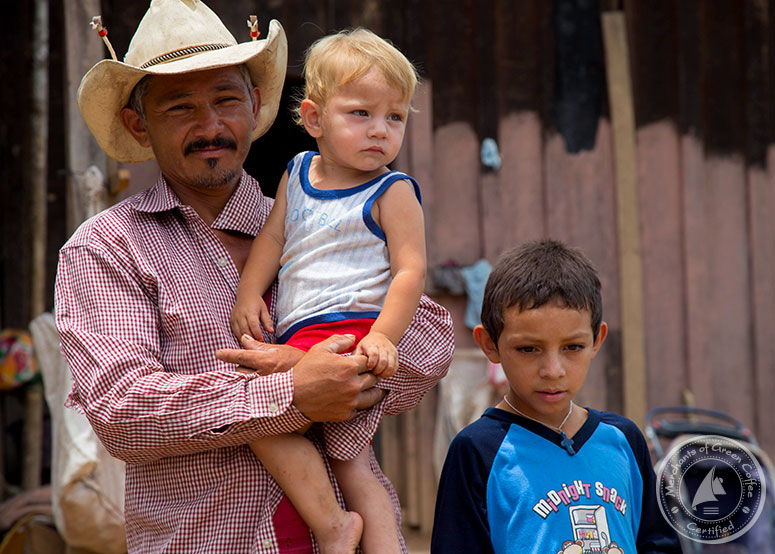
A coffee growing family living below the poverty line lit up in smiles and opened their doors to share everything they had with us visitors. For many producers here, the opportunity to see and engage with a ‘foreigner’ may only happen once in a lifetime.
Evening or “Noche”
By the end of the work day, which is usually around 5pm, it’s time for dinner. “La Cena”. A typical plate of beans, “these can never be missing from the plate”, says Cindy; plus eggs from their own hens; butter and/or cheese; and, finally, bananas picked from their own farm. This is the typical dinner and it’s proven to be both delicious and sustaining. Once or twice a year a family might find themselves enjoying a meal of Honduran-style “pupusas” (grilled corn bread stuffed with beans, cheese and salsa) at the one and only local restaurant in the village.
Parents wash up and settle in quickly after eating since the sun sets between 5:30pm-6:15pm depending on the season. There are no streetlights in Subirana and not every home has electricity, so children can be found outside playing soccer near the patios until sundown; all the while keeping an eye on any drying coffee. The absence of sun gives way to complete darkness and the hum of insects grows louder as the nighttime jungle comes alive.
Here and there, a glow of electric light can be seen through the open walls of cement homes. “Sometimes parents will spend the evenings telling stories of their ancestors, and other times they just relax and watch soap operas until going to bed between 8pm-9pm”, says Cindy. “In the parent’s case, they have to get up early to work; and the children usually have to wake up early to embark on a long walk to school.”
Annual Schedule
Coffee is grown in tropical regions close to the equator, in what is known as the coffee “bean belt”. Each growing region’s season is slightly different in timing, depending on the general habitat and variations in climactic conditions, such as temperature and rainfall. Nevertheless, the season, and therefore the “routine”, involved in coffee production has many similarities across the world.
Planned calendars are created month-to-month, Cindy explains, in which her family maps out the weekly intervals of tasks; like fertilizing, pruning, cleaning, sprouting new seedlings, and so on. Each farm is an average of three hectares in size (about 2.4 acres), and farmers have to be very careful about how they plan maintenance so as not to harm any trees.
Many growers are responsible for finding a buyer for their own coffee, so market instability is a major concern. During COVID-19 the world’s attention was necessarily occupied and it forced individuals’ attention inwards. This only worked to intensify concerns of market instability for coffee producers.
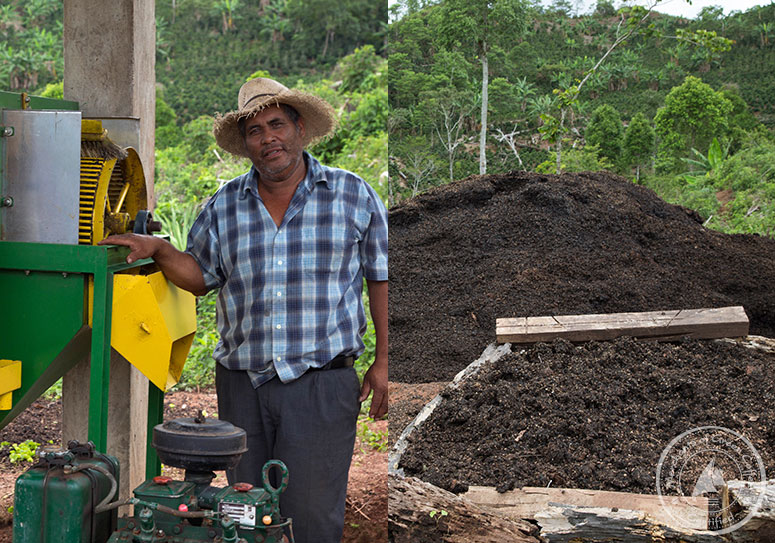
In the case of Cindy’s cooperative, a central depulping machine (used for removing the cherry from the seeds) is an important part of their coffee supply chain and is shared by the community. The machine is powered by biofuel, which is grown quickly and cheaply in the region; an in addition to processing the coffee this machine provides a source of organic fertilizer for the coffee trees in the form of compost.
April-July
April signals the start of the growing season for Cindy’s coffee from Honduras. As the trees prepare for new growth, producers spend their time cleaning and maintaining the farm after the big harvest.
This includes brush cleaning the trees; removing old and broken branches; applying organic fertilizer; removing foliage so the tree has more strength when developing fruit; and making seedbeds for future coffee farms.
August-September
Beginning in August and continuing to September, the coffee plants go into bloom producing a plethora of delicate, white flowers. The air is filled with the scent of jasmine, and birds and insects can be found hard at work pollinating.
Farmers take this time to rest and prepare for the harvest season. It’s not all rest, though. This is the time when the trees are actively getting ready to bear the next four months’ worth of fruit harvest and finding a buyer for the coffee becomes critical in these months. As the trees fill with flowers, producers are working to estimate the size of their harvest and cooperate with their neighbours to seek and secure a buyer at a decent price.
Late September-March
This is the coffee fruiting season and by far the busiest season in Subirana. Flowers yield to berries (called “coffee cherries”) that turn from green, to yellow, to red, indicating peak ripeness. But this ripening process doesn’t happen all at once. Fruiting, and thus harvesting, begins in September and continues steadily all the way through to March.
The intensive tasks of both picking each and every ripe cherry by hand, and the multiple stages of processing needed throughout these four months requires a sudden mass amount of labour. Social distancing during harvesting has proven to be more difficult for producers, most of whom cannot afford to take time off for quarantine. Coffee is their livelihood and it needs to come off the trees and be sold.
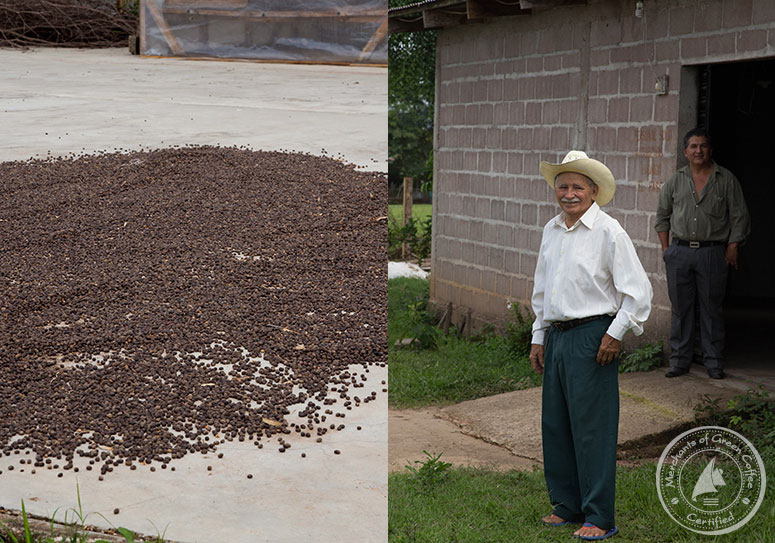
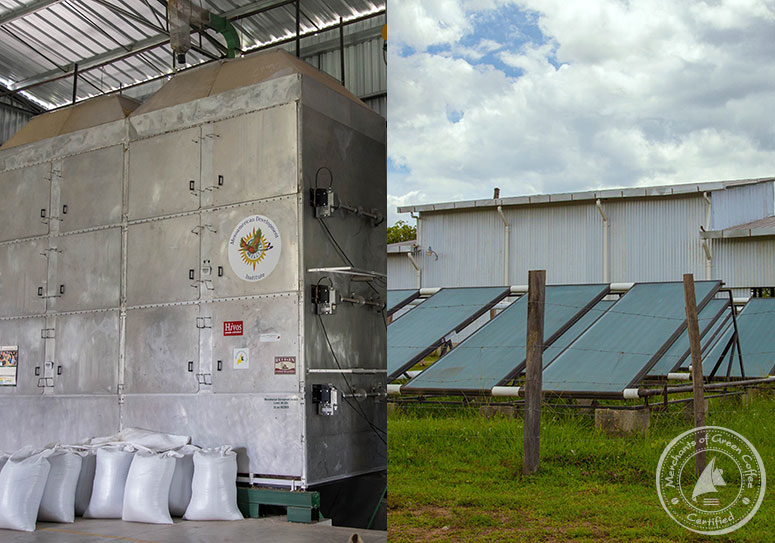
This image shows a traditional method for processing (drying) the coffee, found in Honduras and used throughout Central America. This method (referred to as “sun dried coffee”) is environmentally-friendly; however, it’s also very labour intensive, requiring two weeks of manual raking, plus the drying tends to be less even due to sporadic rainfall and general humidity.Mechanical processing machines powered by solar energy are a unique and modern innovation (called “solar dried coffee”), first employed by Cindy’s cooperative in this region. This off-grid, commercial-scale technology has a number of benefits over patio raking; mainly uniform drying within a much shorter time-frame using clean energy. The facility also provides employment for the region; including jobs in coffee sorting, bagging, quality control and grading.
Coffee Farming in Today’s Context
The Bad News
Climate change and COVID-19 have made coffee farming more risky due to market instability and this is affecting all coffee farmers across the world. Extreme weather events (i.e. droughts, prolonged rainy seasons, hurricanes, etc.) and longer-term habitat changes (i.e. riverbeds drying up, species biodiversity loss, etc.) due to climate change also threaten coffee farmers livelihoods.
The Upside
Both climate change and COVID-19 are revealing how important it is for the world to work together; which means they are providing even more reason for consumers to think about and establish a deeper connection with the people who grow their coffee.
The 3 Keys to the Best Tasting Coffee is one of our most foundational pieces of coffee education since it defines what it takes to make the best possible cups. It also boils down the core lessons behind the lesser-known education we’ve been teaching in our coffee school for the past 2 decades.
These 3 keys are irrefutable coffee facts, grouped together and defined so any cup that properly passes through each of them can be objectively considered to be one of the best-tasting cups possible. And the best part? Anyone can choose to take control of their coffee quality after learning these keys. Taking the time to become aware is the first step in changing our habits so they are better for us and for nature.
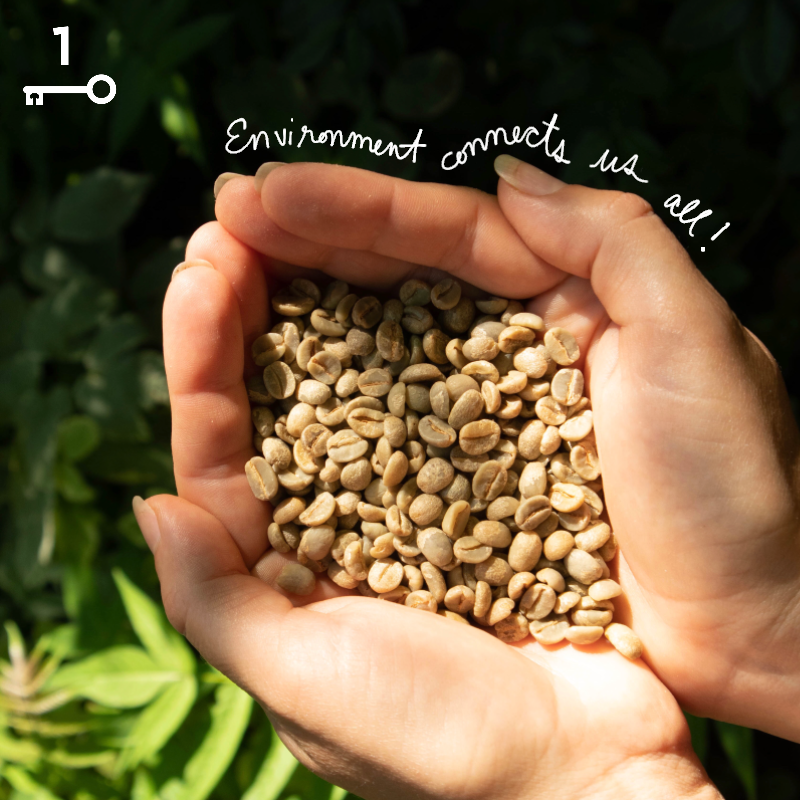
Key #1: Quality Green Beans
Quality Green Beans is about honouring nature.
It’s about sourcing green coffee beans that are grown with care as close to real, biodiverse nature as possible. The best coffees are grown at high altitudes in the shade of other trees within an ecologically diverse forest. High elevation coffees are naturally better tasting because coffee trees grown at high elevations concentrate more sugars in their beans, which give them a naturally sweeter flavour. Coffee trees grown in healthy forests also benefit from nutrient-rich soil and environmental diversity, both of which work to protect the plants and improve their growth and resilience.
Quality green coffee beans are also defined by consistent, ecologically sustainable processing, as well as careful sorting and selection. Certifications, such as Fair Trade & Organic, add another layer of quality because third-party verification acts as an ecological and financial incentive to growers for producing better quality coffee at one end of the supply chain and proves consumer support for better products at the other end.
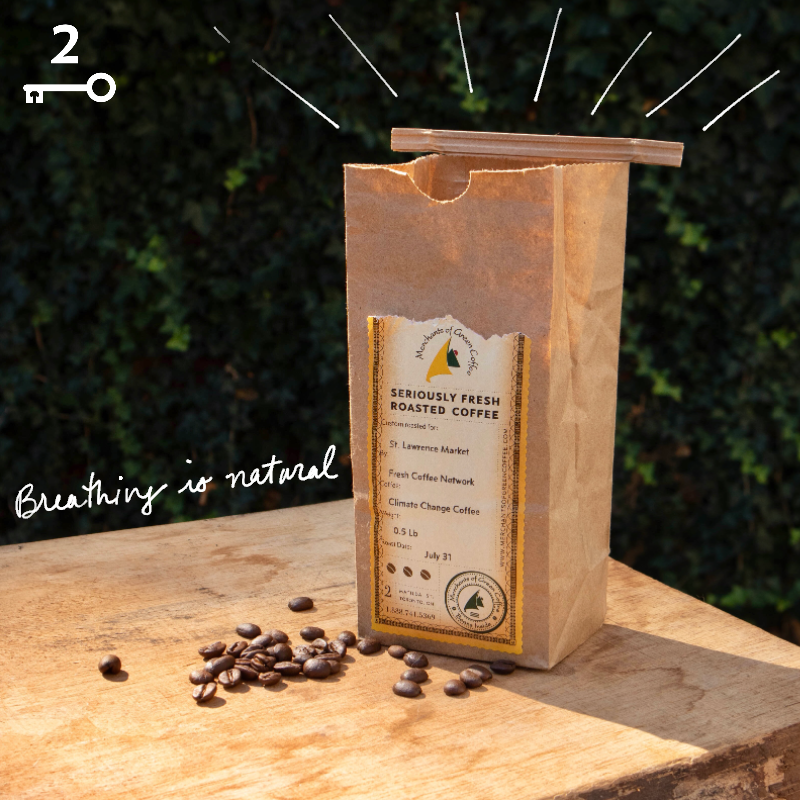
Key #2: Freshness of the Roast
Freshness of the Roast is about learning from nature rather than attempting to control it.
Once roasted, coffee beans begin to oxidize (a staling process that lasts 5-7 days) so freshness of the roast is about capturing the best and sweetest natural flavours locked within the green beans by consuming the roasted version within 5-7 days from the date of roasting. No form of consumer packaging today can properly preserve coffee’s freshness once roasted, so those with a true understanding of the natural process of coffee oxidation know that trying is futile.
In short, coffee (like bread), has a short shelf life. It oxidizes! It’s twice as complex as the finest red wine and just as volatile. The oxidation period for coffee is just 5-7 days from the date of roasting. Therefore, roasted coffee must be consumed within 5 days of roasting to be considered truly fresh, and ground just before brewing. Fresh roasted coffee, consumed within 3 days of roasting is dramatically superior in taste to any other and this is because quality beans are naturally sweet and lively tasting.
Coffee Fact: Truly fresh coffee is also better for human health! This is due to the fact that fresh beans that have not had the chance to oxidize contain antioxidants (which are volatile and disappear rapidly as the coffee stales). Truly fresh-roasted coffee also tastes so good that many people find they can eliminate cream and/or sugar from their daily morning routine.
Key #3: Proper Brewing
Proper Brewing is about being present in the moment.
It’s about taking time to learn about the brewing process and practising conscious brewing in order to extract the best and maximum flavour from freshly roasted coffee beans.
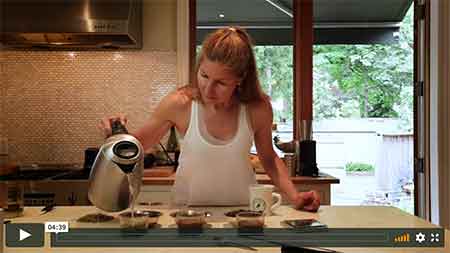
Coffee School Lesson: In order to extract the full spectrum of flavour, proper brewing requires pure and clean water at a temperature of 195-205°F (just off the boil). Grinds should extract (“steep” or come in contact with the hot water) for anywhere from 1-3 minutes depending on the grind size. For maximum freshness, a fresh brewed cup should be consumed within 10 minutes of brewing in order to fully experience the volatile flavours and aromas. (We recommend starting with 10g of whole coffee beans per 8oz cup. Then, adjust the ratios based on your personal brew strength preferences)
Proper brewing is also about being a conservationist, practising low footprint brewing and taking care to extract as much flavour from the grinds as possible, not stranding or wasting any grinds.
Key #4: Good Company (Special Key!)
Good Company is about recognizing that we need one another in order to survive and thrive.
It’s about paying tribute to the fact that the roots of coffee culture (Ethiopia) made it a special ceremony that was shared in the company of friends, family and people we care about. Today, coffee is a global product shared between all cultures and has the potential to connect us in a deeper way. People sharing good coffee with the people they care for has the power to spark a chain reaction of positive global change.
Good Company is also about how good companies around the world need to align in order to make coffee better now and in the future.
And, because we all know how busy life can be … if drinking cups alone, Good Company can be interpreted as choosing a good company to buy beans from, setting a clear intention for the day, taking action on something meaningful that benefits others … you get the idea! Cheers to a future with better coffee ☕️🌿
The q-grading of coffee is a process that consumers don’t typically get access to and Cafe Solar® is not your average coffee. It’s the first solar dried coffee (processed using renewable solar energy). It’s also a supply of green coffee that’s built to mitigate climate change and its q-grading process (which is the confirmation of any coffee’s quality) represents an important aspect of this specialty coffee’s unique, transparent supply chain.
Q-grading this year’s (2019/2020) harvest of Cafe Solar, is Karen Jull, accredited Merchants Q-grader and Grocery Brand Manager for Cafe Solar coffee.
Karen’s extensive background in food product development combined with her past experience cupping and grading various solar dried coffee harvests over the years qualify her in providing a valuable sensory perspective on the development of this solar dried coffee. See our “Corporate Documents” page to download a copy of Karen’s q-grade results, in which she scored the coffee an 82.75.
A completely impartial at-source Q-grading of this coffee was also completed by ICAFE (the official Honduran coffee marketing board) prior to it being shipped from Honduras (in which the coffee scored a 85.09).
What’s the point of a Q-grading?
This grading is a systematic analysis of the producer’s hard work and applies a credible grading to the coffee.
How does this coffee compare/contrast with other coffees out there?
Scores above 80 signify “specialty” coffee and these coffees are considered to be in the top tier of world coffee quality. Individual scores depend on the subtle characteristics of each origin and the subjective experience of the cupper.
About Cafe Solar: Green Coffee Mitigating Climate Change
Cafe Solar is a green coffee and a first-of-its-kind solar dried coffee, which refers to its processing method. These green beans are fully washed, and then dried using 100% renewable energy supplied by advanced solar energy technology. This solar powered processing equipment stops the deforestation currently fueling wood-powered coffee processors … 16,000 acres of forest are currently lost each year as a cheap fuel source for conventional coffee processing!
This coffee is also grown using a restorative system of agriculture, which encourages growers to allow forest to regenerate on their lands. It’s coffee farming with a built-in reforestation program and it’s called Integrated Open Canopy™.
By stopping the current deforestation caused by coffee’s processing and growing additional forests, Cafe Solar coffee is not just sustainable coffee to produce … it’s a restorative coffee!
Our First Sampling of this Coffee
As soon as it arrives we break open a bag with great anticipation and try it.
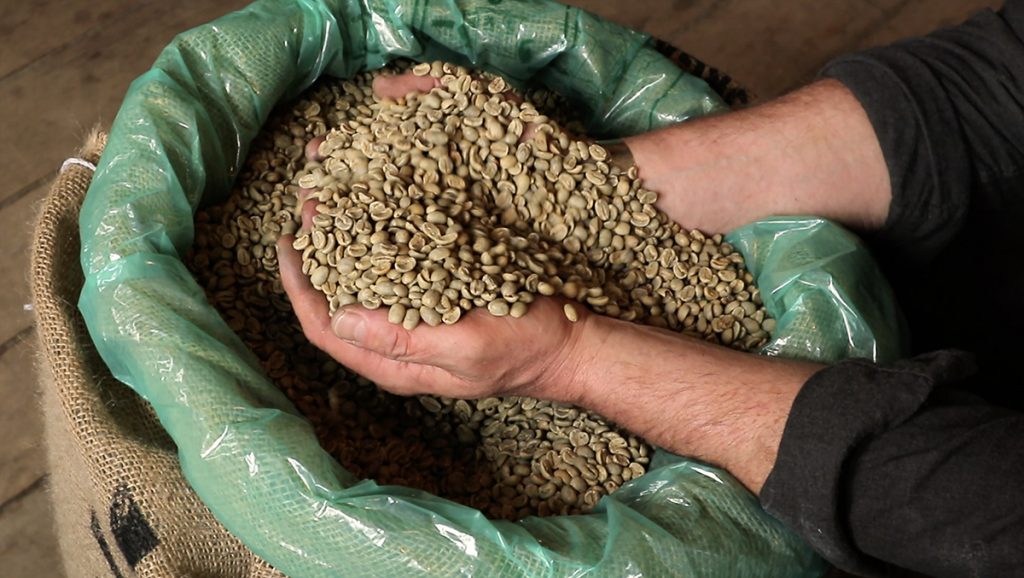
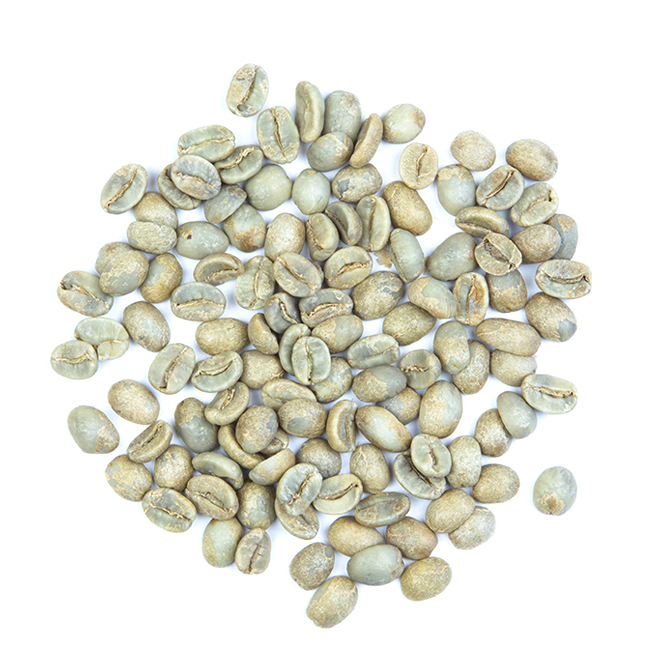
Breaking into the first burlap bag from the 2019/2020 harvest of Cafe Solar®. The green beans smell amazing and it’s a beautifully uniform example of quality, solar dried coffee.
Our Very First Tasting Notes
Roast Degree: 6/10 Acidity: 4/10 Body: 7-8/10 Complexity: Dark chocolate, lemon acidity, light grassy end notes, nice creamy body, no dry flavour, earthy, hints of fermented cassava, hazelnut, toasted coconut.
Then we commit to drinking this coffee at various roast degrees on a weekly basis throughout the year until the next harvest, taking notes all along the way. It takes time to truly familiarize oneself with a coffee, as nuances present themselves depending on a wide variety of factors; including the setting, the brew method, the brewer, the freshness of the roast, etc.
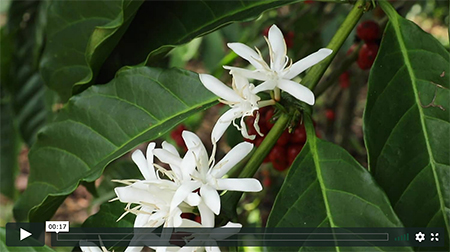
Beautiful, jasmine-scented coffee flowers for all the mothers out there in celebration of Mother’s (Earth) Day! As a company, we made the decision to celebrate only universal holidays; and we can’t help but feel that Mother’s Day is essential on the principal that mothers are special and need our attention. We work to celebrate mothers today and every day, and coffee flowers (+ an environmental coffee message) are our way of showing that we care.
Learn More About Coffee Flowers and How Coffee Grows
Good green coffee thrives naturally in biodiverse forests because coffee grows on trees! Well, technically coffee trees are an evergreen shrub that grow amoung the dappled shade of other tropical trees and serve as an under-story canopy layer in tropical forests.
“Coffea Arabica” (the Latin name for coffee trees) produce one harvest of coffee beans per year (sometimes two, depending on the location and the season). Leading up to harvest season the trees burst into flower, which smells incredible and fills an entire growing region with the sweet scent of jasmine. Coffee flowers are self-pollinating by nature (which means they don’t require insect pollination with other coffee trees’ flowers); however, studies show that when pollination does occur (from bees, birds, and bat activity) coffee trees produce more cherries of a higher quality.
After flowering the trees produce fruit, known as “coffee cherries”, and inside of each cherry are two seeds. These seeds are coffee beans! And (fun fact) the average coffee tree on a farm yields approximately 1,500 cherries; which equates to 3,000 beans; which is about 1lb of coffee beans per year. This makes it easy to figure out how many coffee trees it takes to provide the average household with coffee for a year, and the answer is thirty. Thirty coffee trees means tens of thousands of coffee flowers. This is a side of coffee that we don’t often think about or have the pleasure of seeing, but one which connects us to where coffee grows, the people who grow it, and inevitably to the most important mother of all … Nature.
There are three critical keys to making the best tasting coffee, regardless of what coffee camp you belong to. As with fine wine, the quality of the coffee begins with the quality of the fruit.
#1 – The Bean
The first key to great coffee is the Quality of the Green Bean.
The best cup of coffee starts with the best beans, and the best beans are high-elevation; arabica fairly traded and grown organically. Coffee production that includes innovations such as, restorative agriculture, advanced sorting and processing equipment, and better packaging/storage facilities for export, also play a role in increasing a coffee’s overall quality.
Today, it is difficult for the consumer to easily identify the grade and where their beans are coming from.
#2 – The Roast
The second key to great coffee is the Freshness of the Roast.
For coffee to be considered truly fresh, it must be consumed within 5 to 7 days (at most!) after roasting; within 3 hours of grinding; and within 15 minutes of brewing.
Proper coffee brewing requires water just off the boil; 90°C to 98°C/195°F to 205°F. This temperature is necessary to extract the full range of flavours from freshly roasted and freshly ground coffee. The most important aspect of the brewing process is the brewer’s understanding of, and ability to, apply the proper temperature and extraction time.
Most coffee today is poorly extracted due to a general lack of understanding of the science behind coffee brewing, coupled with the way brewing equipment is designed, used and cleaned.
Why 3 Keys?
At Merchants of Green Coffee, we’re committed to educating coffee consumers for the love of coffee; its art, its science, history, and its rituals. Our 3 Keys to the Best Tasting Coffee encompass all the good that exists in coffee distilled into three simple, albeit critical components, or keys. Anyone who uses these 3 keys in their coffee ritual can be assured they’ll be crafting some of the best cups possible.
Update: Since publishing this, we have officially added A fourth key, and we’re now calling it our “3+ Keys to the Best Tasting Coffee”. (Read About it Here)